Twenty Buildings, One Yes — Two Months Searching for an Embassy Residence in Tokyo
What You Will Learn
Q. Can a foreign embassy rent a residence in Tokyo?
Q. Why are tower apartments often unsuitable for an embassy residence in Tokyo?
Q. Will an official car fit in Tokyo mechanical parking?
Q. What does a Japan-side broker deliver if nothing gets signed?
The inquiry I nearly deleted
In May 2026, an email came in through the contact form on this site. It asked us to find a residence in Tokyo for a foreign ambassador. The sender was a company in India — not a real estate firm.
I will be honest: I assumed it was spam. An unsolicited English email asking a small Tokyo brokerage to find an ambassador’s residence is not, on its face, a credible thing. I replied without expecting anything.
It was real.
An ambassador of a small country was being posted from India to Japan, and a residence had to be found on the Japanese side. How the request reached a one-person brokerage in Minato, I still do not know.
What mattered was the shape of the problem. The client was not a real estate company and had no presence in Japan. They needed someone here who could actually move — find candidates, call landlords, arrange viewings, and judge whether something fit.
Three conditions, none of them rare
Once the brief was laid out, it was clear that the difficulty was not the quality of the property. It was the combination.
There were three conditions. Pets allowed. The embassy as the tenant on the lease. Parking for the official car. Individually, none of them is unusual. Together, in Minato, they very nearly do not exist.
An embassy is a tenant many landlords refuse
Start with the tenant. A significant number of buildings will not accept a foreign mission as a lessee at all.
Among those that will, some apply a further condition: embassies of G20 or OECD member states only. Tenant selection by the standing of the country, written into the leasing policy.
The client’s country belonged to neither group. So even after reaching a building that accepts embassies, they were on the wrong side of a second filter. Two barriers, not one.
To be clear about where the problem sits: this is how parts of the Japanese leasing market are run. It is not a judgment about the country, and it is not one I share.
Pets remove the towers
Look for the space, security, and services a residence needs in Minato, and tower apartments come up first. Most of them prohibit pets. The category that fits best on every other axis is removed wholesale by one clause.
The car does not fit
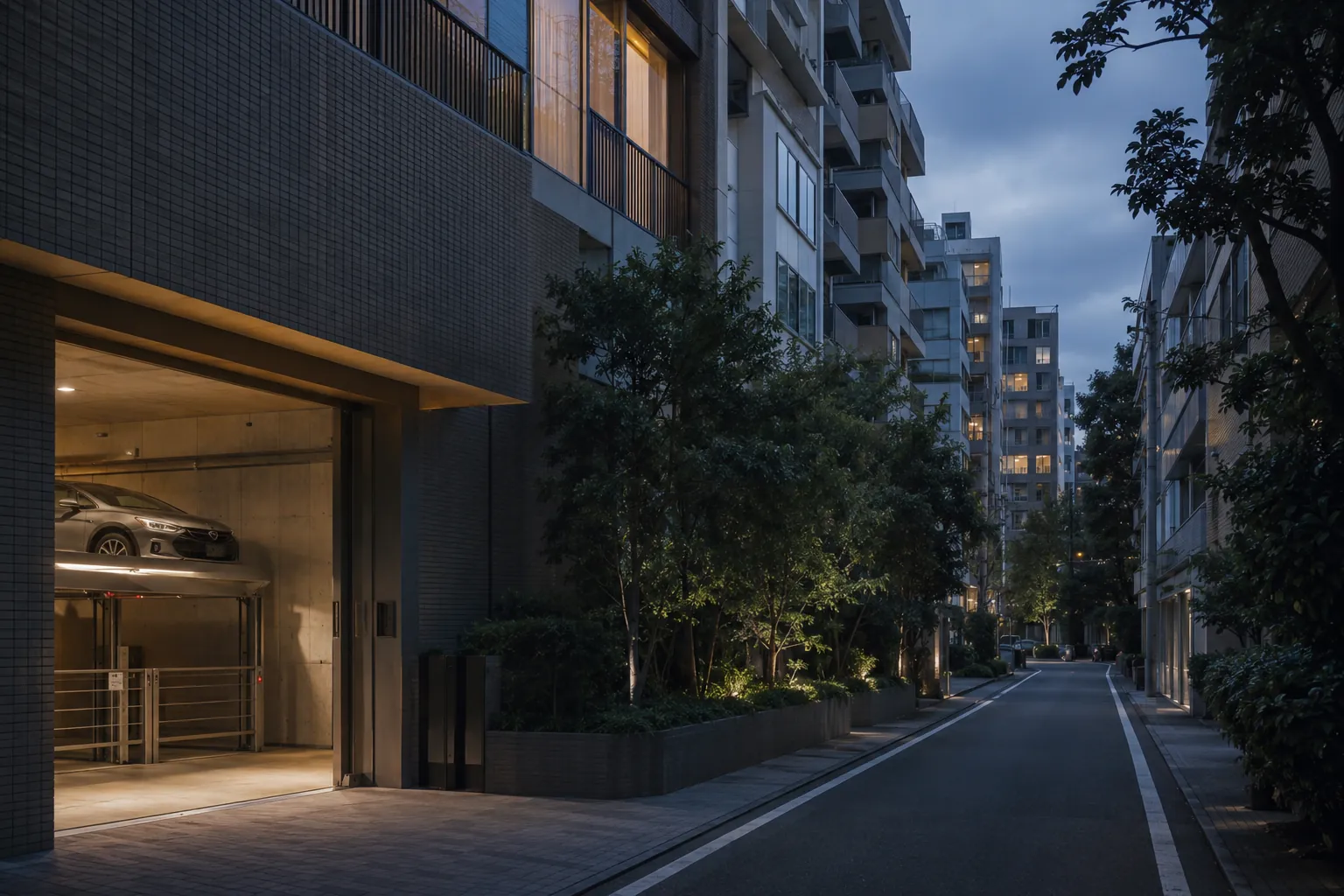
Then parking. The standard width limit for mechanical parking is 1,850 mm. A BMW or Mercedes sedan — the kind of car actually used to move a diplomat — does not fit inside it.
“Parking available” and “the official car can be parked here” are two different statements.
None of this appears in a listing. “Embassy OK,” “pets OK,” “parking available” are either missing or do not match what you find when you call. From overseas, no amount of reading gets you to it.
And there was only one chance to view
One more constraint, unrelated to the property. The client was not in Japan. They would fly in for viewings, and whatever could be shown during that stay was all they would see. “Let’s look again next month” was not available.
So the goal of the search was not a list of candidates. It was to have at least one property, with the landlord’s consent already secured, ready to be viewed on the day they landed.
Twenty buildings, one yes
We worked Minato and the surrounding area against those three conditions.
We approached twenty buildings. One said yes.
It was a rental apartment next to the U.S. Embassy, at around ¥2 million a month. We viewed it.
I learned afterwards that the client had also engaged three other firms. Four firms, two months. Three viewings happened in total. One of them, arranged by another firm, was the apartment next door to the one I showed. The third was a property some distance away.
Four firms searched independently, and two of them arrived at the same building.
Honestly, I had thought we might not be able to show anything at all. Given the constraints, that was the realistic downside. Getting one viewing to happen on the day the client landed felt like the minimum job done, not a win.
I would not have rented it either
Nothing was signed.
The client’s stated reason was that it did not meet their requirements. My own reaction, standing inside it, was simpler: I would not rent this.
The rent and the layout did not match. The bedrooms were small; one of them was tiny. On the second floor, there was no view.
The decisive detail was the living room wall. It was clad in a wood board finish — attractive as interior design, but nothing can be hung on it. In an ordinary home, “nice wood-panelled wall” is the end of the sentence. In a residence where a country receives guests and displays its own things, a wall that cannot be used is a functional defect.
¥2 million a month, for that.
One thing did earn a mark in its favour: the mechanical parking took an Alphard. Against a 1,850 mm standard, that is worth something. It does not make the place a residence.
Where the push would have gone
I did not press it.
This is exactly the point where a broker pushes. One shot, a client in the country for a limited number of days, nothing else to show — every condition for a hard close was in place.
In this case, the language barrier made a hard close physically impossible. The client does not speak Japanese, and an involved persuasion cannot travel through that gap. The listing agent who let us in barely spoke at all. Perhaps that was simply his manner. Either way, there was no sales pressure in the room.
For the record: I do not push Japanese clients either. I did not decline to push because I was unable to. Ask me to look for another apartment and I will look. I will not tell you something fits when it does not.
The relationship continued. We have since discussed a studio unit in Minato and traded notes on their activity in India. The deal fell through; the working relationship did not.
What we actually delivered
Twenty buildings, one that would have taken the tenant, and that one not worth the rent. That was the conclusion of two months.
And it is not only my reading. Four firms searched separately over the same period and produced three viewings between them, two of which were in the same building. This was not a question of who searched better. There was that little in the market.
What the search showed is that Japanese rental housing is not designed around a foreign mission as the tenant. Landlords select tenants by the standing of the country. The category best suited on space and security is removed by a pet clause. The standard parking width does not match the cars diplomats are driven in. None of this is malice — it is what you get when a market is optimised for ordinary domestic demand. But the mismatch is real, and it is invisible from outside. It is not in the listings or on the portals. You find it by calling landlords, walking the rooms, and measuring the parking bay.
One more thing worth saying about high-end Minato rentals: the price is attached to the address, not necessarily to what is inside. ¥2 million a month buys the right to live in that area. It does not guarantee that the layout, the finish, or the view are at that level. You cannot see that gap in a document.
I should also say that in this line of work, not closing is the normal outcome. When a brief is this constrained, “no” is the default answer and a signed contract is closer to the exception. “It didn’t close” is not the failure of this case.
What the client received was not a property. It was a decision — that under these conditions there is effectively nothing in Tokyo right now — established in two months. Loosen the conditions, raise the budget, shift the timing, or consider something other than a lease: to choose among those, the finding was what they needed first.
The person standing in the middle
There was someone else to protect here: the Indian company that introduced us.
They had presented us to the embassy as the Japan-side partner. Had the Japanese side produced nothing at all, the party losing face would not have been the embassy. It would have been them. We did not close, but a viewing did take place on the dates the client was here, and their position held.
In cross-border work there is almost always someone standing between you and the end client. Misjudge who that person answers to, and when the deal dies the relationship dies with it. It is precisely when nothing gets signed that it matters whether the introducer was protected. I think that is part of why this relationship is still open.
A word on the language barrier as well. It happened to shield the client from a hard sell — but that is luck, not safety. The other side of it is that they could not read what was happening in the room. Being unable to notice that you are being pushed is a worse position to be in than choosing a counterparty who does not push.
And finally, this case was a test of something for me: can I say that there is nothing? After two months with no deal, the pull toward closing anything at all is real. In a market where refusal is the default, pushing trades a low-probability contract for the relationship. Here I did not push, and the relationship is what remained.
If you are working on Japan from outside — as an operator, a fund, or the party standing in the middle — what we do on the Japanese side is set out here.
This article is provided for general informational purposes only and does not constitute advice on any specific transaction or investment decision. For advice on your particular situation, please consult a qualified professional.